A MUSEUM FOR THE CITY

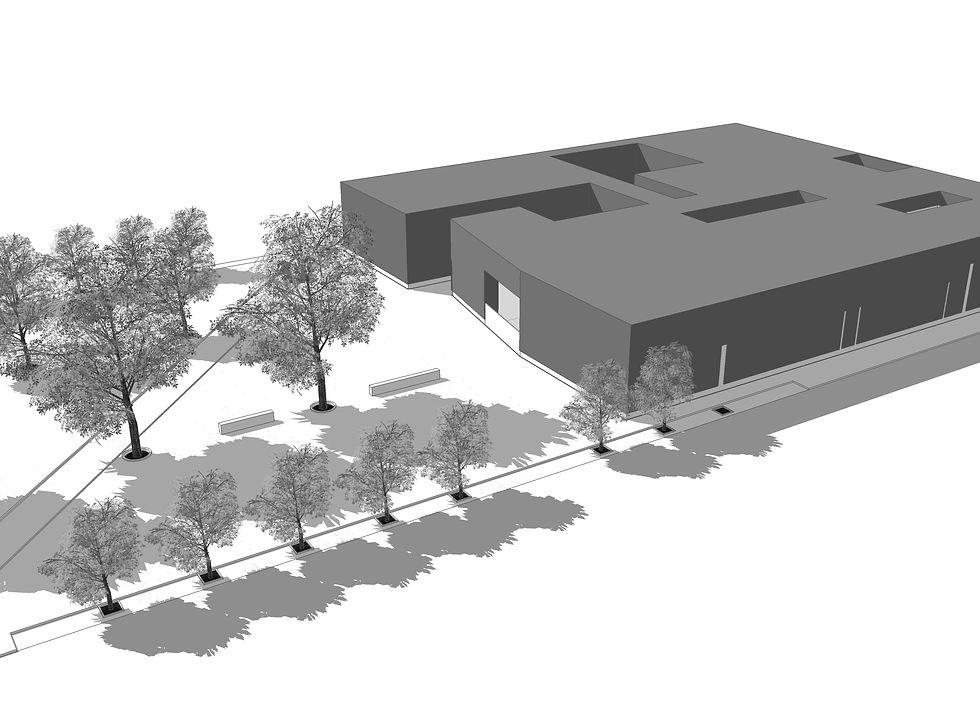
The relationship between the building and its suroundings was developed from the early stages considering the regular tissue of the city but also the profound transformation it is suffering. In the rectangular portion, the diagonal passage across it defines the area that will be the public space and it is marked on the ground as a symbolic representation of the history of the land, for there was a railway line there that can still be seen in the implantation of some surrounding buildings.
The museum has a solid character, intentionally touching the limits of the terain, emerging as a form of exception that nevertheless maintains the conventional notion of block and street that dominates the suroundings. The concept of the building then comes from the confrontation of these ideas: outline and mass. The volume, apparently very dense, is pierced by several courts that streamline the different programmatic areas of the building. The first one corresponds to the entrance of museum, and here the volume turns inside itself indicating the beginning of the architectural experience. This organization provides a more honest link between indoors and outdoors, without compromising the neutrality, peace and quiet needed to receive the expositions and implementation of educational projects.
The material chosen to envelope the building was brushed steel, creating an image of luminosity and to some extent even a reference to how the sea reflects the light. The material is used in rectangular plates that create a grid on the facades, where modules are removed to create the entries for inerior light. These openings are not covered with glass but with polycarbonate sheets because, as previously stated, the intention of the proposal has always been keeping a very controlled environment without interference or distractions from the outside. These vertical openings that punctuate the facades all unite in a horizontal opening that surrounds the entire building at the lower limit. This opening gives the enormous mass some lightnes in its contact with the ground. Finally, these openings to the outside are not designed to function as conventional windows, because the spaces should be open only to the patio spaces, and are covered with fixed panels and LEDs are placed inside, which at night creates a feeling that the building is based on pure light.